Wednesday, March 7, 2012

When the Power Goes Out

Hello again, coming to you from paradise, well, almost paradise!
On some days it is difficult to remind myself that I am living and working in a third (or fourth) world environment. The doctors working here are very conscientious, well trained and qualified. The clinic, though dirty, moves patients through in a productive and orderly fashion. The x-ray department provides good quality films and the portable ultrasound machines are nearly as good as what I am used to working with back home. The surgical suite is clean, well stocked and air conditioned. Anesthesia service functions much the same as in the states. All is well, until the doors fly off. Here is the tale of my last night on call:
The daylight hours had gone well with 3 major gynecology surgeries and a late afternoon Cesarean. I was able to stop work at 5:30 and come home to relax and have one of Tyronza's fine suppers. I was tired and went to bed at 9:30pm only to be awakened by the telephone at 11pm. The emergency room was calling with a patient that had an acute abdomen and they were requesting my presence, so I hurried in to the hospital.
The patient was indeed in great distress with a rapid pulse and low blood pressure. A quick urine pregnancy test was positive and her hemoglobin was 7.6 gm. A few steps over to the clinic allowed me to retrieve my portable ultrasound machine and two minutes later her problem was obvious. An abdomen full of blood confirmed my fear of an ectopic pregnancy. We started two IV's and requested two units of blood for "stat" cross match. It seemed just like the big city; but that was when reality struck and the third-world medicine thing came home to roost.
The power around here is notoriously unreliable. It seems to go off and on multiple times each day and we are use to the big generator kicking on when this happens. This time when the power went off, the big generator didn't come on. A quick check showed that Dixon, one of the station's trouble shooters, was on generator call. He only carried a cell phone, which was also out and so I had to send the hospital guard out to find him. Meanwhile the patient in shock is needing blood; but, without power the cross match is stalled! Dixon was finally located and was able to start the little generator. The big generator could not be resuscitated! I thought my problems were solved. I had power in the ER and in surgery, but soon discovered there was still no power in the lab. The lab guy, Andy, was sitting over there in total darkness and was still no help. He reported that he could do a group and Rh on the patient, if he had a flashlight. I retrieved my headlamp from the clinic and gave it to him with my blessing. In a few minutes , he discovered that the patient had 0 negative blood. He handed me two units of blood and I headed back to the ER. On inspection, I discovered there was no Rh factor on either unit. Both the ER staff and Andy said this was alright, because all people in Papua New Guinea are Rh negative. Andy said, "We never check the Rh factor on any blood we use." I had seen several locals that looked like there was a "honky" in the wood pile, but said nothing. We finally gave the patient the two units without difficulty and surgery, two hours late, took care of the problem. By 2 am I was back in bed, only to be awakened at 3:30.
This time it was a nurse in delivery who had just delivered a term baby with meconium aspiration. The power had again gone off at a strategic moment and she was not able to suction the baby very well. I tried to suction the child out and do percussions and drainage as best I could, but he was retracting a lot and I felt sure he would die. In the third world there are no respirators; even if we had reliable power to run them. The baby would have to "take a chance".
The next morning, the nurse seemed pleased and the baby did seem to be breathing easier. I peeled back the diaper for a closer look and was met with a big stream of urine followed by a full arrest. He would not resuscitate!
Life is cheap here in the bush and with unreliable power it doesn't show any sign of getting better. It is fortunate there is always reliable power with God. He is always there to make our light shine; we need only to believe and ask.
I hope your day goes better than mine. I think about you guys a lot.
God Bless,
Scot & Tyronza

Monday, February 27, 2012

Typical day for Scot

Hello from beautiful Papua New Guinea. It has been a beautiful week here. We have had no rain for the past six days, so we are beginning to be concerned about the cistern, but other than that we are both healthy and doing fine.
I thought I would take some time, like Tyronza, and let you know what my typical day and week is like.
I rise at 5:45am each day. All is calm except for the whistling of the locusts and the crowing of the local kakarukas (roosters). The locusts look like our cicadas, but make a buzzing whistle-like noise that sounds like an alarm clock going off. This serenade usually lasts about 30 minutes. During this time, I am up walking with several other mission doctors and Brutus. The course is two miles.
Brutus is a beautiful black Labrador. He is not very well trained and it is hard to say who is taking whom for a walk. He is always eager to go and seems to be slowing improving in the obedience department.
After the walk, a shower and breakfast are in order. The shower water is left in the tank from the previous days sun - heat and so is only warm, but feels good after a long walk. Breakfast consists of oatmeal, bananas, pineapple, toast from Tyronza's bread and tea. The bananas here are like nothing I have ever experienced in the states. My favorites are called apple bananas. They are short, firm and very sweet. They taste a bit alike an apple and go down very well. There are over 200 varieties of bananas here, some very large and some small. Most are yellow but a few are red. Some are for eating and some are for cooking (strang banana). As I write this note, I have had my eye on a particularly large bunch of eating bananas. I hope to have the whole bunch hanging from my porch very soon.
At 8am, after breakfast, I walk 2-3 blocks to the hospital to start by medical day. I usually have 7-8 Gynecology patients to round on, then 20-30 obstetric patients to see. After rounds I either go to surgery or to the clinic.
The clinic consists of gynecology patients that have mostly been screened by the family doctors and I see them to consult and review for possible surgery. There are also problem obstetric patients to see. I usually do a physical exam and ultrasound on each one. I see about 15 clinic patients each day.
Scheduled surgeries are primarily done on Tuesdays and Thursdays and unscheduled surgeries fit in on a daily basis as needed. Each week I do 6-8 major cases plus 4-6 unscheduled c-sections and ectopics. I also assist the general surgeon, Dr. Jim Radcliff, on his major cases, usually 6-8 per week.
We break for lunch at noon each day and are usually back in the clinic by 1pm. The work day ends at 5 or before, except for call. I am being on call every other night and every other weekend for obstetrics and gynecology.
My days are fairly busy, but I do find time to enjoy this beautiful place. God's creations are so astounding!
I hope all of you are well and staying busy. God bless you and keep you safe. I hope to write again soon. (Mi raitem yu bihain sun.)
Scot
for pictures:  http://www.facebook.com/media/set/?set=a.250305375044841.59195.100001961413037&type=3&l=209e4ae86b
e is not very w He H H

Thursday, February 23, 2012

Typical Day for Tyronza

A typical PNG day for Tyronza: T gets up around 5:30am and checks emails and facebook. She is happy to receive messages from family and friends. She then wakes Scot and they go out for a morning exercise walk and run at 6:00. There are several other volunteers, missionaries and a few locals who exercise at this time of the morning. At 6:00 it is still dark, but begins to lighten very quickly. By 7am, we are typically back at our place and heading to the showers or getting the breakfast ready. By 8am, Scot is heading to the hospital for either clinic or surgery. Tyronza is cleaning up breakfast dishes and preparing for her day. She tries to leave the house by 9-9:30. She often begins bread making or clothes washing before leaving. She also needs to have the lunch preparation started and the dinner menu planned (making sure she has all the ingredients).
By 9:30, T is helping either at the hospital, storeroom or field office. Depending upon where she is needed, she might be cleaning a room at the hospital, sorting or unpacking items in the storeroom or helping with filing and bookkeeping in the office. (The field office is the Nazarene Melanesian Regional Office and covers several countries.)
By 11:30-12 noon, T is back at the house completing preparation for lunch and serving Scot and usually two others.  We are living in the Barnabas House; a house that can sleep up to 24. There are two wings, with a bathroom on each wing and a large kitchen and living area between. Fortunately, there are typically only two couples in it during the months we are in PNG and on occasion a single medical student or resident volunteering  for a month. After we leave in May, there will be two large groups arriving to work for two weeks each.) After eating lunch, Scot returns to the hospital for either clinic patients or surgery. Tyronza cleans up after lunch, brings clothes in from the clothes line or puts the loaves of bread in the oven.
There is usually an hour or two of down time and then it is time to start dinner preparation. (Time for picture taking, reviewing recipes, catching up on daily Bible devotions, a little bit of reading, or a Tok Pisin - pidgin lesson.) For dinner there is usually 4-8 to be served. The most common main meals are chicken or ground beef. There is a large variety of vegetables available. Experimenting is fun and usually turns out. This week we have had tacos, banana pancakes and chicken potpie for dinner. For desert there has been pineapple (fresh) upside down cake, homemade chocolate banana ice cream, bread pudding and tonight homemade mango (fresh) ice cream. Lunches are usually soup (pumpkin and carrot, cream of broccoli, zucchini and tomato) and sandwiches (tuna salad, grilled cheese and tomato, PB&J). The "More with Less" cookbook that Laura Meece gave T last year is getting a good use. (Thank you, Laura.) Dinner is usually served between 6-6:30.
Scot is great helping with evening dishes, cutting up fresh pineapple or opening and shaving the coconut. He is typically back from the hospital by 5. He is at the hospital Monday-Friday and is on call for OB/Gyn every other night and every other weekend.
A typical evening has friends coming over for dinner or for games later. There are many board games: Settlers, Monopoly, etc. and dice games: Zilch, also Pictionary and Pit, etc. Visiting with the other volunteers and the missionaries is a lot of fun and we appreciate their company. There is much talk and laughter. Fellowship with others is such a blessing. Scot enjoys having a new audience for his tales!
We are typically preparing for bed by 9-9:30pm. We enjoy our time in PNG and find it very rewarding. This simple lifestyle is good for the heart, mind and soul. It feels like stepping back in time 50 years.
http://www.facebook.com/media/set/?set=a.250305375044841.59195.100001961413037&type=3&l=209e4ae86b

Saturday, February 18, 2012

Rain in PNG


It has been a beautiful first two weeks here in Papua New Guinea, except for the rain. Rain is a popular product of the Western Highlands Province and our hospital is no exception. It has rained 12 of our first 14 days here. The locals report the annual rainfall was a staggering 150+ inches this past year. The wet season extends from November to June with the typical dry season being July through September.
Too much rain can cause flooding and the dreaded mud slides. A few weeks ago there was a mud slide that took out a small village with loss of life and in one case a P.M.V. (public motor vehicle) was covered as it traveled along with 21 resulting deaths and only one survivor.
Those of you in southeast Missouri are well acquainted with flooding. Around here, this is a major problem with the local farms and gardens. Farmers in the US try to take advantage of the available moisture, while people in PNG dig special drainage channels throughout their gardens to carry the water away.
To me, adequate rain means a good supply of water in my cistern, so there will be a plentiful water supply for drinking, bathing, washing dishes, laundry and flushing the toilet!
The typical day here on the station starts with mist trapped by the mountains filling the valleys. This greatly limits early morning visibility. The mist is usually gone by 8 am and intense high-altitude sun with a few passing clouds predominates until mid afternoon.  The sun at high altitude is dangerous and sunburn can get you in 30-45 minutes without protection.  Temperatures are usually quite mild to the upper 70's and low 80's. By 2-3 pm the clouds start to stack up and by 5 pm the rain starts. Rainfall can last through the night, but usually stops by dawn. Precipitation is mostly light, but can be intense - especially at night.
Too little rain can also be a problem at the station. This means dry cisterns and rationing our water for drinking, showers and toilet flushing.
God's secret to the existence of plants and animals on our planet involves a balance of soil, sun and rain. Without each of these there can be no life. Let us pray for a year without flood or drought and of course for my cistern to remain full.
See you later (lukim yu bihain),
Scot & Tyronza

http://www.facebook.com/media/set/?set=a.250305375044841.59195.100001961413037&type=3&l=209e4ae86b


Sunday, February 12, 2012

Back to PNG

Tyronza and I arrived about 11 days ago on February 1st, written 1/2/12 here in PNG. Things have been very busy here and I have been slow to open up the blog site - so here I go!
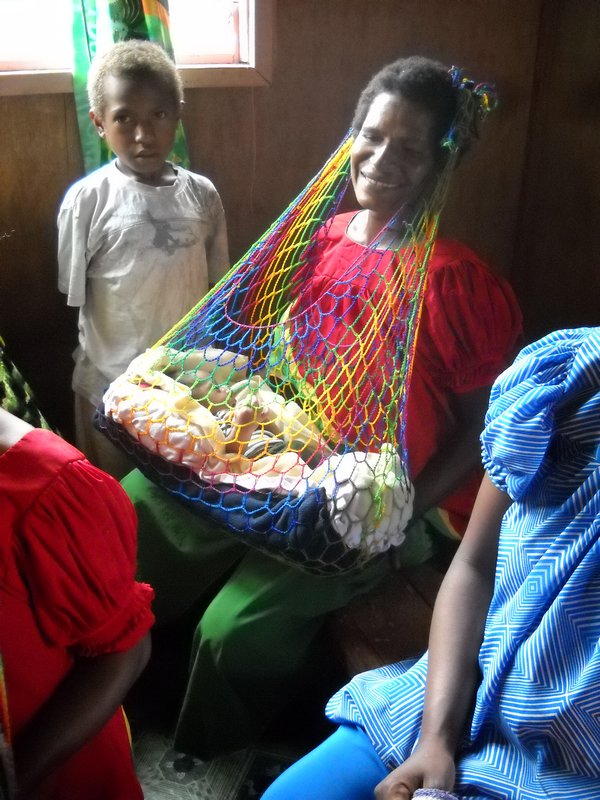
Today, I thought I would comment about the use of the tote sack - or as the natives here call it the "bilum" . There are few trucks or cars in this country, so everything is carried by hand, or in most cases in a bilum ( which in tok pisin means bag).
The bilum comes in many sizes. Small ones are used as a purse or man-bag for the essentials. Larger ones may carry fire wood, kaukau (yams), vegetables, fruit or corn. These hang on the back from a wide strap that is suspended from the forehead. I have even seen loose weave bilums used to carry babies. These bilums seem similar to a papoose board used by American Indians, but the loose weave allows air in to keep the baby cool. The forehead strap provides quick access to tend the child.
Patients coming in for surgery usually bring all their hospital supplies in a bilum. These may contain clothing, bedding supplies, food, cooking and laundry supplies. The lowly bilum seems to be an ideal carrying tool for these people. It is totally recyclable (typically crocheted from yarn), handy and a colorful symbol of this culture.
Medically speaking, things are much the same as last time. I have already performed ten major surgeries, which include three ectopic pregnancies. One of the major surgeries was for a thirty-five pound cystic ovarian teratoma.
Hospital call this time is much better. I am on one day and then off the next and am on only every other weekend. Clinic patients are still seen Monday through Friday.
Thanks for listening! God bless all you folks. Please pray for us.
Scot & Tyronza

pictures can be viewed at:

http://www.facebook.com/media/set/?set=a.250305375044841.59195.100001961413037&type=3&l=209e4ae86b

Wednesday, May 4, 2011

Third World Medicine Up Close and Personal

Hello again from Papua New Guinea,

Hope all is well for you folks in the USA. Tyronza and I are doing well. I have been having problems with my back, but Tyronza found a lumbar belt for me and helps a lot. We will be coming home in just under two weeks and I thought I would tell you about the filth involved in third world medicine.
Most of you have never been to a third world hospital, so let me tell you the two hospitals in Cape are very clean and well maintained. The hospital here is less than two years old, but seem to be well worn already. If anything is broken, it takes forever to get repaired.

The floors are usually filthy, even though they are dry swept twice daily and wet mopped two-three times a week. The patients are mostly barefoot, and most of the feet are caked with mud. It usually rains each evening so the mud is particularly bad early in the morning and the dust is bad in the afternoon.


The sinks in the hospital only have cold water and half of the faucets don't work. Often the sinks seem to be full of used gloves, dirty instruments and wet scraps of paper and dressing materials. There is usually a bar of soap at each sink and a used towel to dry your hands with. I have taken to carrying a small hand towel in my pocket to dry my hands with.

The counters are often cluttered with dirty gloves and used syringes. Sometimes there are ants and bugs crawling on the beds, floor and counters. I have started trying to tidy up whenever possible, but it seems to be a losing battle.

The OR is a much cleaner place, although I did see an ant crawling on the

drapes during one case. Anesthesia commented that it was probably a sterile ant! All patients having surgery are given both pre-op and post-op antibiotics, usually chloramphenacol. I have had only one wound infection so far, and it was very small. One day I was waiting for a surgery to start, sitting in the surgical lounge. In the space of 15-20 minute, while I waited, I was able to kill 50 ants and 3 cockroaches.

Surgical instruments are sterilized just like they are in the US. The hospital has two large autoclaves that are kept busy. Surgical gloves are washed in bleach water and recycled as non sterile gloves. Lap sponges are washed in bleach water and re-autoclaved. The bovie cords and grounding pads are all recycled by washing in a chemical soak and then rinsing in sterile water just prior to the case. I have been using the same vacuum extractor since I arrived. Each time it is soaked in chemical and then rinsed in sterile water. I have probably used the same device on at least a dozen deliveries. Medicines and suture material are almost always expired, but they seem to work well and cause no ill effects.

Lighting is a problem. The OR area does have good lighting, but the wards have only sparse florescent lights. I have taken to using a head lamp for most of the obstetrical repair problems and that seems to work well.
The ultrasound transducer is usually gooey from the previous exam. I have found that a roll of paper towels works well to wipe the patient off and keep the machine clean. I try to wash the transducer head with soap and water, whenever it is available.

The nurses have an interesting technique for checking patients in labor. All laboring patients are allowed to labor on their beds in the ward. When they need to be checked, which is only occasionally, the patient walks back to delivery bay #1. Each mother has her own bowl of betadine soap sitting out on the counter with her name attached. When she is examined, I put on a sterile glove, then ask the patient what her name is. I then dip the glove in the bowl with her name on it and do the check. When the exam is over, she goes back to her bed in the ward and her bowl, along with the other six or so women in labor , is left on the counter in bay #1 ready for the next check.

That's all for now,
Dr. P
pictures can be viewed at:
http://www.facebook.com/media/set/fbx/?set=a.114240695317977.19428.100001961413037&l=a20582723c
http://www.facebook.com/media/set/fbx/?set=a.114388571969856.19532.100001961413037&l=0b5634e363

Sunday, May 1, 2011

Patient Care

Greetings from Papua New Guinea:
Today was a particularly exciting day, as I wound up doing four caesarean sections along with vaginal deliveries and rounds. About half way through rounds, a patient was brought in on the back of a small truck. She had been laboring out in the bush. She was obviously very pregnant and seizing. Her husband had used his cigarette lighter to place between her teeth, so she had a good airway; but she was seizing almost continuously. She looked very swollen and obviously had eclampia. The nurses told me this happens three to four times per year.
My nurses were quick to respond with an IV and we immediately gave her 6 grams of magnesium sulfate and valium. It took a total of 25 milligrams of IV valium to stop the seizures. Once she was stable, we took her straight to surgery. There was thick meconium, but the baby was fine.
After surgery, the patient continued to have problems. Although there were no more seizures, her blood pressure and urinary output gave me fits. By midnight of that day, she was only making 5 cc/hr of urine. I called the pharmacy to request some manitol, but was told none was available. They also did not have any plasma. I thought about using serum from the blood bank, but felt the risk of AIDS and Hepatitis was too high and I would try to do without. The following morning, I went over to the pharmacy and was finally able to find some German manitol, "osmofundin." After I gave the osmofundin and some lasix, her output was great and she seemed much better. Her blood pressure remained high and required hydralazine IV to keep it down for the next few days.


Around three hours later, a woman came in with rupture of membranes and she was breech. She had also had a previous C/S. Although we had been delivering v-backs and breeches, I discovered there were no Pipper forceps available and I did not feel good about a breech v-back, so we did c-section #2.
Later that same afternoon, one of the patients in labor ruptured her membranes and the umbilical cord washed out. The baby was in distress, but with oxygen, salbutamol, and knee chest position it soon sounded fine. A crash c-section around here takes one hour to get ready. We kept the mother in knee chest for that hour and the baby came out looking good.
I had just finished the third c-section, when another mother came in with ruptured water and another cord prolapse. This time the patient was not contracting and the baby did not sound distressed. We took our time and finished the fourth c-section of the day without incident. This baby was also fine.
Obstetrics around here is just like in Missouri - either feast or famine! Thankfully, there are not too many days like this one. We do around 30 deliveries a week in Kudjip and approximately 4-5 of these usually are c-sections. The section rate is slightly less than 15% and outcomes are good, unless the babies are too small. If you have read my other blog notes, you may recall the small babies I have told you about. The 1200 gram baby has survived and is now nearly ready for discharge, but the 1000 gram baby died of necrotizing enterocolitis.
No other exciting news to tell you and we are now just three weeks away from our departure to come back home. I hope to see you soon.

Dr. P

pictures can be viewed at:
http://www.facebook.com/media/set/fbx/?set=a.114240695317977.19428.100001961413037&l=a20582723c
http://www.facebook.com/media/set/fbx/?set=a.114388571969856.19532.100001961413037&l=0b5634e363