Tyronza and I arrived about 11 days ago on February 1st, written 1/2/12 here in PNG. Things have been very busy here and I have been slow to open up the blog site - so here I go!
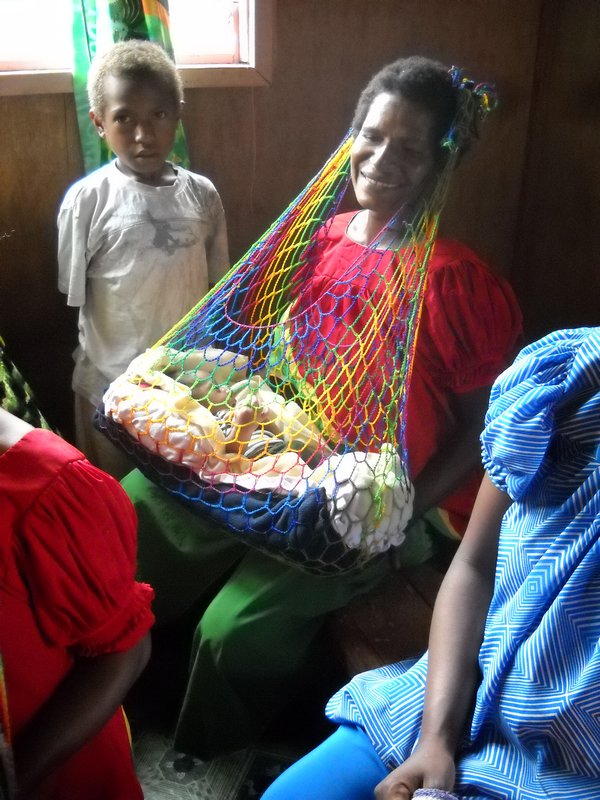
Today, I thought I would comment about the use of the tote sack - or as the natives here call it the "bilum" . There are few trucks or cars in this country, so everything is carried by hand, or in most cases in a bilum ( which in tok pisin means bag).
The bilum comes in many sizes. Small ones are used as a purse or man-bag for the essentials. Larger ones may carry fire wood, kaukau (yams), vegetables, fruit or corn. These hang on the back from a wide strap that is suspended from the forehead. I have even seen loose weave bilums used to carry babies. These bilums seem similar to a papoose board used by American Indians, but the loose weave allows air in to keep the baby cool. The forehead strap provides quick access to tend the child.
Patients coming in for surgery usually bring all their hospital supplies in a bilum. These may contain clothing, bedding supplies, food, cooking and laundry supplies. The lowly bilum seems to be an ideal carrying tool for these people. It is totally recyclable (typically crocheted from yarn), handy and a colorful symbol of this culture.
Medically speaking, things are much the same as last time. I have already performed ten major surgeries, which include three ectopic pregnancies. One of the major surgeries was for a thirty-five pound cystic ovarian teratoma.
Hospital call this time is much better. I am on one day and then off the next and am on only every other weekend. Clinic patients are still seen Monday through Friday.
Thanks for listening! God bless all you folks. Please pray for us.
Scot & Tyronza
pictures can be viewed at:
http://www.facebook.com/media/set/?set=a.250305375044841.59195.100001961413037&type=3&l=209e4ae86b
Sunday, February 12, 2012
Wednesday, May 4, 2011
Third World Medicine Up Close and Personal
Hello again from Papua New Guinea,
Hope all is well for you folks in the USA. Tyronza and I are doing well. I have been having problems with my back, but Tyronza found a lumbar belt for me and helps a lot. We will be coming home in just under two weeks and I thought I would tell you about the filth involved in third world medicine.
Most of you have never been to a third world hospital, so let me tell you the two hospitals in Cape are very clean and well maintained. The hospital here is less than two years old, but seem to be well worn already. If anything is broken, it takes forever to get repaired.
The floors are usually filthy, even though they are dry swept twice daily and wet mopped two-three times a week. The patients are mostly barefoot, and most of the feet are caked with mud. It usually rains each evening so the mud is particularly bad early in the morning and the dust is bad in the afternoon.
The sinks in the hospital only have cold water and half of the faucets don't work. Often the sinks seem to be full of used gloves, dirty instruments and wet scraps of paper and dressing materials. There is usually a bar of soap at each sink and a used towel to dry your hands with. I have taken to carrying a small hand towel in my pocket to dry my hands with.
The counters are often cluttered with dirty gloves and used syringes. Sometimes there are ants and bugs crawling on the beds, floor and counters. I have started trying to tidy up whenever possible, but it seems to be a losing battle.
The OR is a much cleaner place, although I did see an ant crawling on the
drapes during one case. Anesthesia commented that it was probably a sterile ant! All patients having surgery are given both pre-op and post-op antibiotics, usually chloramphenacol. I have had only one wound infection so far, and it was very small. One day I was waiting for a surgery to start, sitting in the surgical lounge. In the space of 15-20 minute, while I waited, I was able to kill 50 ants and 3 cockroaches.
Surgical instruments are sterilized just like they are in the US. The hospital has two large autoclaves that are kept busy. Surgical gloves are washed in bleach water and recycled as non sterile gloves. Lap sponges are washed in bleach water and re-autoclaved. The bovie cords and grounding pads are all recycled by washing in a chemical soak and then rinsing in sterile water just prior to the case. I have been using the same vacuum extractor since I arrived. Each time it is soaked in chemical and then rinsed in sterile water. I have probably used the same device on at least a dozen deliveries. Medicines and suture material are almost always expired, but they seem to work well and cause no ill effects.
Lighting is a problem. The OR area does have good lighting, but the wards have only sparse florescent lights. I have taken to using a head lamp for most of the obstetrical repair problems and that seems to work well.
The ultrasound transducer is usually gooey from the previous exam. I have found that a roll of paper towels works well to wipe the patient off and keep the machine clean. I try to wash the transducer head with soap and water, whenever it is available.
The nurses have an interesting technique for checking patients in labor. All laboring patients are allowed to labor on their beds in the ward. When they need to be checked, which is only occasionally, the patient walks back to delivery bay #1. Each mother has her own bowl of betadine soap sitting out on the counter with her name attached. When she is examined, I put on a sterile glove, then ask the patient what her name is. I then dip the glove in the bowl with her name on it and do the check. When the exam is over, she goes back to her bed in the ward and her bowl, along with the other six or so women in labor , is left on the counter in bay #1 ready for the next check.
That's all for now,
Dr. P
pictures can be viewed at:
http://www.facebook.com/media/set/fbx/?set=a.114240695317977.19428.100001961413037&l=a20582723c
http://www.facebook.com/media/set/fbx/?set=a.114388571969856.19532.100001961413037&l=0b5634e363
Hope all is well for you folks in the USA. Tyronza and I are doing well. I have been having problems with my back, but Tyronza found a lumbar belt for me and helps a lot. We will be coming home in just under two weeks and I thought I would tell you about the filth involved in third world medicine.
Most of you have never been to a third world hospital, so let me tell you the two hospitals in Cape are very clean and well maintained. The hospital here is less than two years old, but seem to be well worn already. If anything is broken, it takes forever to get repaired.
The floors are usually filthy, even though they are dry swept twice daily and wet mopped two-three times a week. The patients are mostly barefoot, and most of the feet are caked with mud. It usually rains each evening so the mud is particularly bad early in the morning and the dust is bad in the afternoon.
The sinks in the hospital only have cold water and half of the faucets don't work. Often the sinks seem to be full of used gloves, dirty instruments and wet scraps of paper and dressing materials. There is usually a bar of soap at each sink and a used towel to dry your hands with. I have taken to carrying a small hand towel in my pocket to dry my hands with.
The counters are often cluttered with dirty gloves and used syringes. Sometimes there are ants and bugs crawling on the beds, floor and counters. I have started trying to tidy up whenever possible, but it seems to be a losing battle.
The OR is a much cleaner place, although I did see an ant crawling on the
drapes during one case. Anesthesia commented that it was probably a sterile ant! All patients having surgery are given both pre-op and post-op antibiotics, usually chloramphenacol. I have had only one wound infection so far, and it was very small. One day I was waiting for a surgery to start, sitting in the surgical lounge. In the space of 15-20 minute, while I waited, I was able to kill 50 ants and 3 cockroaches.
Surgical instruments are sterilized just like they are in the US. The hospital has two large autoclaves that are kept busy. Surgical gloves are washed in bleach water and recycled as non sterile gloves. Lap sponges are washed in bleach water and re-autoclaved. The bovie cords and grounding pads are all recycled by washing in a chemical soak and then rinsing in sterile water just prior to the case. I have been using the same vacuum extractor since I arrived. Each time it is soaked in chemical and then rinsed in sterile water. I have probably used the same device on at least a dozen deliveries. Medicines and suture material are almost always expired, but they seem to work well and cause no ill effects.
Lighting is a problem. The OR area does have good lighting, but the wards have only sparse florescent lights. I have taken to using a head lamp for most of the obstetrical repair problems and that seems to work well.
The ultrasound transducer is usually gooey from the previous exam. I have found that a roll of paper towels works well to wipe the patient off and keep the machine clean. I try to wash the transducer head with soap and water, whenever it is available.
The nurses have an interesting technique for checking patients in labor. All laboring patients are allowed to labor on their beds in the ward. When they need to be checked, which is only occasionally, the patient walks back to delivery bay #1. Each mother has her own bowl of betadine soap sitting out on the counter with her name attached. When she is examined, I put on a sterile glove, then ask the patient what her name is. I then dip the glove in the bowl with her name on it and do the check. When the exam is over, she goes back to her bed in the ward and her bowl, along with the other six or so women in labor , is left on the counter in bay #1 ready for the next check.
That's all for now,
Dr. P
pictures can be viewed at:
http://www.facebook.com/media/set/fbx/?set=a.114240695317977.19428.100001961413037&l=a20582723c
http://www.facebook.com/media/set/fbx/?set=a.114388571969856.19532.100001961413037&l=0b5634e363
Sunday, May 1, 2011
Patient Care
Greetings from Papua New Guinea:
Today was a particularly exciting day, as I wound up doing four caesarean sections along with vaginal deliveries and rounds. About half way through rounds, a patient was brought in on the back of a small truck. She had been laboring out in the bush. She was obviously very pregnant and seizing. Her husband had used his cigarette lighter to place between her teeth, so she had a good airway; but she was seizing almost continuously. She looked very swollen and obviously had eclampia. The nurses told me this happens three to four times per year.
My nurses were quick to respond with an IV and we immediately gave her 6 grams of magnesium sulfate and valium. It took a total of 25 milligrams of IV valium to stop the seizures. Once she was stable, we took her straight to surgery. There was thick meconium, but the baby was fine.
After surgery, the patient continued to have problems. Although there were no more seizures, her blood pressure and urinary output gave me fits. By midnight of that day, she was only making 5 cc/hr of urine. I called the pharmacy to request some manitol, but was told none was available. They also did not have any plasma. I thought about using serum from the blood bank, but felt the risk of AIDS and Hepatitis was too high and I would try to do without. The following morning, I went over to the pharmacy and was finally able to find some German manitol, "osmofundin." After I gave the osmofundin and some lasix, her output was great and she seemed much better. Her blood pressure remained high and required hydralazine IV to keep it down for the next few days.
Around three hours later, a woman came in with rupture of membranes and she was breech. She had also had a previous C/S. Although we had been delivering v-backs and breeches, I discovered there were no Pipper forceps available and I did not feel good about a breech v-back, so we did c-section #2.
Later that same afternoon, one of the patients in labor ruptured her membranes and the umbilical cord washed out. The baby was in distress, but with oxygen, salbutamol, and knee chest position it soon sounded fine. A crash c-section around here takes one hour to get ready. We kept the mother in knee chest for that hour and the baby came out looking good.
I had just finished the third c-section, when another mother came in with ruptured water and another cord prolapse. This time the patient was not contracting and the baby did not sound distressed. We took our time and finished the fourth c-section of the day without incident. This baby was also fine.
Obstetrics around here is just like in Missouri - either feast or famine! Thankfully, there are not too many days like this one. We do around 30 deliveries a week in Kudjip and approximately 4-5 of these usually are c-sections. The section rate is slightly less than 15% and outcomes are good, unless the babies are too small. If you have read my other blog notes, you may recall the small babies I have told you about. The 1200 gram baby has survived and is now nearly ready for discharge, but the 1000 gram baby died of necrotizing enterocolitis.
No other exciting news to tell you and we are now just three weeks away from our departure to come back home. I hope to see you soon.
Dr. P
pictures can be viewed at:
http://www.facebook.com/media/set/fbx/?set=a.114240695317977.19428.100001961413037&l=a20582723c
http://www.facebook.com/media/set/fbx/?set=a.114388571969856.19532.100001961413037&l=0b5634e363
Today was a particularly exciting day, as I wound up doing four caesarean sections along with vaginal deliveries and rounds. About half way through rounds, a patient was brought in on the back of a small truck. She had been laboring out in the bush. She was obviously very pregnant and seizing. Her husband had used his cigarette lighter to place between her teeth, so she had a good airway; but she was seizing almost continuously. She looked very swollen and obviously had eclampia. The nurses told me this happens three to four times per year.
My nurses were quick to respond with an IV and we immediately gave her 6 grams of magnesium sulfate and valium. It took a total of 25 milligrams of IV valium to stop the seizures. Once she was stable, we took her straight to surgery. There was thick meconium, but the baby was fine.
After surgery, the patient continued to have problems. Although there were no more seizures, her blood pressure and urinary output gave me fits. By midnight of that day, she was only making 5 cc/hr of urine. I called the pharmacy to request some manitol, but was told none was available. They also did not have any plasma. I thought about using serum from the blood bank, but felt the risk of AIDS and Hepatitis was too high and I would try to do without. The following morning, I went over to the pharmacy and was finally able to find some German manitol, "osmofundin." After I gave the osmofundin and some lasix, her output was great and she seemed much better. Her blood pressure remained high and required hydralazine IV to keep it down for the next few days.
Around three hours later, a woman came in with rupture of membranes and she was breech. She had also had a previous C/S. Although we had been delivering v-backs and breeches, I discovered there were no Pipper forceps available and I did not feel good about a breech v-back, so we did c-section #2.
Later that same afternoon, one of the patients in labor ruptured her membranes and the umbilical cord washed out. The baby was in distress, but with oxygen, salbutamol, and knee chest position it soon sounded fine. A crash c-section around here takes one hour to get ready. We kept the mother in knee chest for that hour and the baby came out looking good.
I had just finished the third c-section, when another mother came in with ruptured water and another cord prolapse. This time the patient was not contracting and the baby did not sound distressed. We took our time and finished the fourth c-section of the day without incident. This baby was also fine.
Obstetrics around here is just like in Missouri - either feast or famine! Thankfully, there are not too many days like this one. We do around 30 deliveries a week in Kudjip and approximately 4-5 of these usually are c-sections. The section rate is slightly less than 15% and outcomes are good, unless the babies are too small. If you have read my other blog notes, you may recall the small babies I have told you about. The 1200 gram baby has survived and is now nearly ready for discharge, but the 1000 gram baby died of necrotizing enterocolitis.
No other exciting news to tell you and we are now just three weeks away from our departure to come back home. I hope to see you soon.
Dr. P
pictures can be viewed at:
http://www.facebook.com/media/set/fbx/?set=a.114240695317977.19428.100001961413037&l=a20582723c
http://www.facebook.com/media/set/fbx/?set=a.114388571969856.19532.100001961413037&l=0b5634e363
Monday, April 25, 2011
PNG People
Another day in paradise is at a close and I thought I might reflect on the people and some of their idiosyncrasies. People here are much the same as elsewhere around the world. Some things about them reflect well and others not so good. Sounds like home, doesn't it?
Most of the folks in our area of Kudjip are called highlanders. They are a mixture of Solomon Islander and Aboriginal. These people have occupied the highland area for close to 50 thousand years. I don't think there was much change until the last 60-70 years. These people are only one or two generations out of the stone age.
The original highlanders have a rather primitive look about them with sloping foreheads and prominent brows. Their skin is medium dark and hair is bushy and black, although the children often have light colored hair, secondary to protein deficiency. They are very clan and tribe oriented. For many centuries, they have lived rather segregated lives in small villages. The villages often had only limited contact, usually, related to tribal warfare. For this reason, there was a lot of inbreeding and most people, male and female tend to look a lot alike. This is a real problem for me in clinic and on rounds. I keep thinking I have already seen this person, when it was really their neighbor.
The tribal thing is very prominent in elections and disputes. They seem to always take the side of their clan no matter what, even if the person is not particularly good or representative of their views. They will still vote for them, simply because they are from their tribe. (Tyronza thinks this is similar to Republicans and Democrats back home!) This leads to conflict and tribal warfare and machete injuries.
The favorite weapon and tool here is the machete. They are always attacking one another or someone from another tribe. This keeps the Emergency Room busy with "chop" injuries. One fellow had both feet amputated - courtesy of the neighboring tribe. (He was drunk and went into another village bragging about being involved in another chopping incident on one of their tribesmen. They retaliated!) Most people seem to survive the chop injuries. Thank the Lord there are few guns!
The children here seem very happy, even in abject poverty. Most are well cared for by parents, relatives, or other members of the village. Childhood mortality is high, secondary to illness (i.e. pneumonia, dysentery, typhoid and malaria). In the clinic, we see the usual illnesses, but also some of the worst skin ulcers and infections I have ever seen. Newly diagnosed osteomylitis is a daily event around here. Some of the injuries are also rather spectacular. I believe I already told you about the young boy who impaled his chest falling out of a guava tree. He recovered and has already gone home.
Most of you would not like the average highlander PNG diet. Meat is fairly rare, but fruit and fresh vegetables abound. The staple is the "yam" or "kaukau". This is similar to the sweet potato, but much more bland and starchy. Other things commonly grown include: pineapple, coconut, banana, guava, mango, greens, beans, tomato, tree tomato, broccoli, cauliflower, carrots, english (white) potatoes, onions, corn, avocado, asparagus and squash. They do raise chickens and pigs, but are more likely to sell them rather than eat them themselves - same with the vegetables, other than "kaukau" and corn.
Pork if usually consumed at a feast or "mumu". The pig is roasted in the ground with hot rocks and vegetables. This can lead to a condition called "pig-bel" in the young children. Sudden consumption of a large amount of poorly cooked pork is the cause. When the body does not see much meat it lacks the enzymes to digest the meat. As a result the undigested meat sits in the small intestine and grows gas-gangrene organisms, which invade the gut wall and makes the child sick. This problem may require surgery and can cause death. I have seen two cases since my arrival.
The women here in the highlands are a sad story. Most are purchased for "bride-price" from their father for a few pigs and several thousand kina. A kina is currently worth $0.40 and is similar to our dollar. In years past, a kina was actually a sea shell that was used to adorn the neck. The bride-price is usually paid by an older villager, usually from a neighboring village or tribe. A man's wealth is determined by his kina and also by the number of wives and children. The wife seems to be responsible for most of the cooking, cleaning, gardening and child care. If the woman is not able to bear children, they are often cast aside or replaced with a new bride. Most infertility is the result of pelvic infection, probably courtesy of the husband. If the husband is displeased with the woman's performance, she may be beaten. This results in cuts and bruises and may also result in a ruptured spleen. I have been involved in several spleenectomies since my arrival. I have also helped repair several machete wounds to the woman. The favorite injury seems to be a chop across the achilles tendon. Domestic violence is also a major contributor to tribal violence when the woman comes from a different tribe as the husband. Not all domestic violence is from the husband, much is a result of polygamy. The "sister" wives can really have it in for each other! They also know how to use machetes.
So long from PNG. "I will catch you later." (Mi bi kissim yu behain.)
Dr. P
pictures are posted at:
http://www.facebook.com/media/set/fbx/?set=a.114388571969856.19532.100001961413037&l=0b5634e363
http://www.facebook.com/media/set/fbx/?set=a.114240695317977.19428.100001961413037&l=a20582723c
Most of the folks in our area of Kudjip are called highlanders. They are a mixture of Solomon Islander and Aboriginal. These people have occupied the highland area for close to 50 thousand years. I don't think there was much change until the last 60-70 years. These people are only one or two generations out of the stone age.
The original highlanders have a rather primitive look about them with sloping foreheads and prominent brows. Their skin is medium dark and hair is bushy and black, although the children often have light colored hair, secondary to protein deficiency. They are very clan and tribe oriented. For many centuries, they have lived rather segregated lives in small villages. The villages often had only limited contact, usually, related to tribal warfare. For this reason, there was a lot of inbreeding and most people, male and female tend to look a lot alike. This is a real problem for me in clinic and on rounds. I keep thinking I have already seen this person, when it was really their neighbor.
The tribal thing is very prominent in elections and disputes. They seem to always take the side of their clan no matter what, even if the person is not particularly good or representative of their views. They will still vote for them, simply because they are from their tribe. (Tyronza thinks this is similar to Republicans and Democrats back home!) This leads to conflict and tribal warfare and machete injuries.
The favorite weapon and tool here is the machete. They are always attacking one another or someone from another tribe. This keeps the Emergency Room busy with "chop" injuries. One fellow had both feet amputated - courtesy of the neighboring tribe. (He was drunk and went into another village bragging about being involved in another chopping incident on one of their tribesmen. They retaliated!) Most people seem to survive the chop injuries. Thank the Lord there are few guns!
The children here seem very happy, even in abject poverty. Most are well cared for by parents, relatives, or other members of the village. Childhood mortality is high, secondary to illness (i.e. pneumonia, dysentery, typhoid and malaria). In the clinic, we see the usual illnesses, but also some of the worst skin ulcers and infections I have ever seen. Newly diagnosed osteomylitis is a daily event around here. Some of the injuries are also rather spectacular. I believe I already told you about the young boy who impaled his chest falling out of a guava tree. He recovered and has already gone home.
Most of you would not like the average highlander PNG diet. Meat is fairly rare, but fruit and fresh vegetables abound. The staple is the "yam" or "kaukau". This is similar to the sweet potato, but much more bland and starchy. Other things commonly grown include: pineapple, coconut, banana, guava, mango, greens, beans, tomato, tree tomato, broccoli, cauliflower, carrots, english (white) potatoes, onions, corn, avocado, asparagus and squash. They do raise chickens and pigs, but are more likely to sell them rather than eat them themselves - same with the vegetables, other than "kaukau" and corn.
Pork if usually consumed at a feast or "mumu". The pig is roasted in the ground with hot rocks and vegetables. This can lead to a condition called "pig-bel" in the young children. Sudden consumption of a large amount of poorly cooked pork is the cause. When the body does not see much meat it lacks the enzymes to digest the meat. As a result the undigested meat sits in the small intestine and grows gas-gangrene organisms, which invade the gut wall and makes the child sick. This problem may require surgery and can cause death. I have seen two cases since my arrival.
The women here in the highlands are a sad story. Most are purchased for "bride-price" from their father for a few pigs and several thousand kina. A kina is currently worth $0.40 and is similar to our dollar. In years past, a kina was actually a sea shell that was used to adorn the neck. The bride-price is usually paid by an older villager, usually from a neighboring village or tribe. A man's wealth is determined by his kina and also by the number of wives and children. The wife seems to be responsible for most of the cooking, cleaning, gardening and child care. If the woman is not able to bear children, they are often cast aside or replaced with a new bride. Most infertility is the result of pelvic infection, probably courtesy of the husband. If the husband is displeased with the woman's performance, she may be beaten. This results in cuts and bruises and may also result in a ruptured spleen. I have been involved in several spleenectomies since my arrival. I have also helped repair several machete wounds to the woman. The favorite injury seems to be a chop across the achilles tendon. Domestic violence is also a major contributor to tribal violence when the woman comes from a different tribe as the husband. Not all domestic violence is from the husband, much is a result of polygamy. The "sister" wives can really have it in for each other! They also know how to use machetes.
So long from PNG. "I will catch you later." (Mi bi kissim yu behain.)
Dr. P
pictures are posted at:
http://www.facebook.com/media/set/fbx/?set=a.114388571969856.19532.100001961413037&l=0b5634e363
http://www.facebook.com/media/set/fbx/?set=a.114240695317977.19428.100001961413037&l=a20582723c
Sunday, April 24, 2011
Girls Day Out
Last week I had two special opportunities to further experience the culture. On Wednesday, Dr. Stephanie Doenges (medical missionary), Pamela West (volunteer x-ray technician from South Africa) and I went into town, Mt. Hagen, for a girls day out.
The drive to town takes approximately 30-40 minutes and there are numerous potholes that have to be dodged on the narrow two lane road. This road is the highway between the coast and the interior; it is basically the only main road. The driving here is done on the left hand side of the road; however, due to the pothole situation much of the actual driving is in either the middle or right side of the road. There are also numerous (hundreds) of people walking along the edge of the road, or have their vehicles stopped along one side to load or unload cargo or people. It is quite precarious and I am glad that I did not have to drive. There are a number of car accidents and hit pedestrians, but not nearly as many as you would think from the driving conditions. Before we leave the compound, if it is only women going to town, we have to pick up a watch man. This is usually a man from the maintenance area of the hospital with a baseball bat. He will remain with the vehicle to guard it, and us, and to offer any assistance we might need. This sounds rather ominous, but I have never felt threatened or at risk.
Stephanie had made a hair appointment in Mt. Hagen for Wednesday afternoon. She and Pamela were going to make a day off it, with shopping and eating at one of the few restaurants in town. I asked if I could tag along and also get a hair appointment. The three of us left for Mt. Hagen about 8:30 in the morning. We drove the 30-40 minutes and did our shopping at the grocery store.
It was lunch time by then and we headed to the Highlander Restaurant which is located in a hotel. The hotel is under remodeling construction, but the restaurant was open and we had a great lunch - club sandwiches and french fries. It was great and I didn't have to cook it myself, or clean it up afterward! Fantastic!
After lunch, we had time for a little shopping and headed for a thrift shop, where we had fun looking through used clothing! Pamela found a couple of things that worked for her and Stephanie found a large t shirt for sleeping. Then it was on to a stationery shop where I found several articles about PNG that I purchased and hope to share with you when we return home.
In the afternoon we had our hair appointments at Jeyleen's hair salon. It was a rather interesting place, a one person shop. Both Stephanie and I received haircuts and were very pleased with them. It was great to be rid of the shaggy look I had been seeing in the mirror for the past couple of weeks. After the hair appointments, we had time for a quick stop at the local market. We purchased fresh vegetables and also another bilum (purse). There is usually a good selection of both at the market.
By that time, it was close to 5 pm and we needed to be back at the hospital compound before dark. The missionaries try not to have anyone out driving after dark unless absolutely necessary. Both the road conditions and bands of young trouble making men, called rascals, can be a problem best avoided. All together it was a fun day and I really enjoyed getting better acquainted with Stephanie and Pamela.
On Saturday of the same week, I was given the opportunity of flying with MAF (Mission Aviation Fellowship). They are a nonprofit, nondenominational group of pilots and mechanics that fly support to mission stations.
I was able to fly two different circuits. I had to hang around the MAF terminal until there was a flight that had room for me. I few first from Mt. Hagen to Simbai to Kamanbu and back to Mt. Hagen. The two locations were at bush airstrips, mainly grass and mud. I flew with pilot, Mike Bottrell (from Australia), in an Air Van. The airstrip at Kamanbu was 437 meters, a less than 1,500 feet with a 2 1/2% slope. I was glad to just be along for the ride and not trying to land. On takeoff, we were airborne in the last 20 feet.
The second flight was after lunch. Again, I had to hang around the airport until there was an available flight. It was fun visiting with both the MAF pilots and the PNG staff that work with them. They thought a female pilot was rather strange and unusual. The second time around, I flew in a Cessna 206 with Phillip Sutterer; he and his wife are from Switzerland. We flew from Mt. Hagen to Dusin; a grass strip on the peak of the mountain with 460 meters of runway, a 10% slope and at 5,800 ft elevation. The next stop was Singabe and then back to Mt. Hagen.
The weather was rather cloudy and the last two stops had drizzle; I hope to be able to right seat another couple of flights when we return next year. It was great fun and I really appreciate the training and the dedication of the MAF pilots.
I will be posting pictures with a link from facebook. I hope you will be able to see them. We are having a wonderful time with new experiences, new foods and of course, new friends. It is hard to believe we will be returning home in three weeks. We look forward to seeing our Cape friends and family and sharing our tales and photos.
Tyronza (not Dr. P)
pictures can be view at:
http://www.facebook.com/media/set/fbx/?set=a.114240695317977.19428.100001961413037&l=a20582723c
and
http://www.facebook.com/media/set/fbx/?set=a.114388571969856.19532.100001961413037&l=0b5634e363
The drive to town takes approximately 30-40 minutes and there are numerous potholes that have to be dodged on the narrow two lane road. This road is the highway between the coast and the interior; it is basically the only main road. The driving here is done on the left hand side of the road; however, due to the pothole situation much of the actual driving is in either the middle or right side of the road. There are also numerous (hundreds) of people walking along the edge of the road, or have their vehicles stopped along one side to load or unload cargo or people. It is quite precarious and I am glad that I did not have to drive. There are a number of car accidents and hit pedestrians, but not nearly as many as you would think from the driving conditions. Before we leave the compound, if it is only women going to town, we have to pick up a watch man. This is usually a man from the maintenance area of the hospital with a baseball bat. He will remain with the vehicle to guard it, and us, and to offer any assistance we might need. This sounds rather ominous, but I have never felt threatened or at risk.
Stephanie had made a hair appointment in Mt. Hagen for Wednesday afternoon. She and Pamela were going to make a day off it, with shopping and eating at one of the few restaurants in town. I asked if I could tag along and also get a hair appointment. The three of us left for Mt. Hagen about 8:30 in the morning. We drove the 30-40 minutes and did our shopping at the grocery store.
It was lunch time by then and we headed to the Highlander Restaurant which is located in a hotel. The hotel is under remodeling construction, but the restaurant was open and we had a great lunch - club sandwiches and french fries. It was great and I didn't have to cook it myself, or clean it up afterward! Fantastic!
After lunch, we had time for a little shopping and headed for a thrift shop, where we had fun looking through used clothing! Pamela found a couple of things that worked for her and Stephanie found a large t shirt for sleeping. Then it was on to a stationery shop where I found several articles about PNG that I purchased and hope to share with you when we return home.
In the afternoon we had our hair appointments at Jeyleen's hair salon. It was a rather interesting place, a one person shop. Both Stephanie and I received haircuts and were very pleased with them. It was great to be rid of the shaggy look I had been seeing in the mirror for the past couple of weeks. After the hair appointments, we had time for a quick stop at the local market. We purchased fresh vegetables and also another bilum (purse). There is usually a good selection of both at the market.
By that time, it was close to 5 pm and we needed to be back at the hospital compound before dark. The missionaries try not to have anyone out driving after dark unless absolutely necessary. Both the road conditions and bands of young trouble making men, called rascals, can be a problem best avoided. All together it was a fun day and I really enjoyed getting better acquainted with Stephanie and Pamela.
On Saturday of the same week, I was given the opportunity of flying with MAF (Mission Aviation Fellowship). They are a nonprofit, nondenominational group of pilots and mechanics that fly support to mission stations.
I was able to fly two different circuits. I had to hang around the MAF terminal until there was a flight that had room for me. I few first from Mt. Hagen to Simbai to Kamanbu and back to Mt. Hagen. The two locations were at bush airstrips, mainly grass and mud. I flew with pilot, Mike Bottrell (from Australia), in an Air Van. The airstrip at Kamanbu was 437 meters, a less than 1,500 feet with a 2 1/2% slope. I was glad to just be along for the ride and not trying to land. On takeoff, we were airborne in the last 20 feet.
The second flight was after lunch. Again, I had to hang around the airport until there was an available flight. It was fun visiting with both the MAF pilots and the PNG staff that work with them. They thought a female pilot was rather strange and unusual. The second time around, I flew in a Cessna 206 with Phillip Sutterer; he and his wife are from Switzerland. We flew from Mt. Hagen to Dusin; a grass strip on the peak of the mountain with 460 meters of runway, a 10% slope and at 5,800 ft elevation. The next stop was Singabe and then back to Mt. Hagen.
The weather was rather cloudy and the last two stops had drizzle; I hope to be able to right seat another couple of flights when we return next year. It was great fun and I really appreciate the training and the dedication of the MAF pilots.
I will be posting pictures with a link from facebook. I hope you will be able to see them. We are having a wonderful time with new experiences, new foods and of course, new friends. It is hard to believe we will be returning home in three weeks. We look forward to seeing our Cape friends and family and sharing our tales and photos.
Tyronza (not Dr. P)
pictures can be view at:
http://www.facebook.com/media/set/fbx/?set=a.114240695317977.19428.100001961413037&l=a20582723c
and
http://www.facebook.com/media/set/fbx/?set=a.114388571969856.19532.100001961413037&l=0b5634e363
Tuesday, April 19, 2011
Easter
This past Sunday was Palm Sunday, with the week leading into Easter Sunday. I thought I would take some time to share about the beauty of this place. Please take a moment to study the picture I have taken of the "resurrection flower." Look carefully at the cross and you will see the tiny face in God's creation, to act as a reminder of why we are so privileged to serve in his name.
This country is so diverse in both its climate and topography that allowances have been made for many different species of plants and animals. The elevation varies from sea level to 14,780 feet, the top of Mt. Wilhelm.
Beginning at the sea, Papua New Guinea is well known for its coral and beautiful fish and sea life. There are over 60 species of colorful parrot fish, along with many shades of star fish and sponges. Tyronza and I are hoping to go on a short scuba trip before we return, but that depends a great deal on the call schedule. We don't have that worked out yet. (We will definitely plan for scuba on our return trips.)
Inland from the coast is a vast network on marshes and swamps that are inhabited by monkeys and other swamp life. Not many humans live it this area because of the mosquitoes. This area is fed by multiple streams that drain down from the mountains. The largest of these streams is the mighty Sepik River, which allows for navigation far inland from the north coast. Most of the swamps are mangroves which act as a breeding ground for various marine life, including the salt water crocodile.
Along the rivers are the tropical rainforests with towering mahogany and other rainforest trees. Some of the world's largest ferns grow in these areas. There are even some humans that live in the tops of these trees, though they are mostly on the Indonesia side of the island.
The rainforests continue up the mountains so thick that land navigation is nearly impossible, until you get to the high valleys at about 3,000 feet. These high valleys continue up to 8,000 feet and act as the perfect living area for over half of the population of New Guinea.
It is in one of the valleys that the Kudjip Nazarene Hospital is situated. We are at 5-6,000 feet, and are surrounded by vast areas of coffee and tea plantations. Both the coffee and tea grown in this area are very tasty. Every morning I have a big mug of PNG #1 black tea. It is very strong with caffeine and the first brewing is darker than most cups of coffee! Most of the people live in this area, because the climate is so perfect, 60 degrees each night and 80-85 degrees each day. The sun shines most days and it usually rains only at night. This valley is beautiful with all of the tropical foliage and vegetable and flower gardens of the native folks. It is called the Wagi Valley and it was first discovered by explorers in 1930. If you are interested in more information, you can read about it in the book, "First Contact". There are still a few elderly people around who remember that first contact.
Further up the mountainsides, the foliage thins out. The mountains are covered with many small streams of clear, very cold water. At about 10,000 feet, the trees change to evergreen conifers. It occasionally freezes above 10,000 feet and at higher elevations there is a chance of snow. It is rare to see the peaks, as most are cloud or fog covered.
Animals are few and far between here in the Wagi Valley. A tree opossum called a cuscus is common and is eaten or kept as a pet by the natives. There is also a very large bird in the area called a cassowary. It lives in the forest and has been known to attack and kill humans with its sharp talons.
The rain forests are alive with both large and small insects. The butterflies are spectacular. One species is an iridescent blue and about the size of the palm of your hand. This is the home of some 50 different species of the Bird of Paradise. Tyronza was able to get some good pictures of several of these birds and one video of their courtship dance.
This entry began with my desire to share the beauty of the "resurrection flower" with you. Please take time to acknowledge Christ and His great gift to you during this Easter season.
That's all for now. See you soon.
Dr. P
to view pictures go to:
http://www.facebook.com/media/set/fbx/?set=a.114388571969856.19532.100001961413037&l=0b5634e363
Thursday, April 14, 2011
PNG Ultrasound
Hello Again from Papua New Guinea Paradise,
Tyronza and I are well and working hard. I thought you would like to know what the ultrasound machine that we brought along has been up to.
For the trip over, I placed the ultrasound in a laptop case and took it along as a carry on bag. We had no problems getting it through customs, and I was able to protect it and keep it in eye sight.
Once here, I was able to cannibalize and old ultrasound stand for easy operation. I keep the ultrasound with me in the clinic and can easily scan anyone I have examined in just a few minutes. (We thought Tyronza would help in this aspect, but she is working in other areas.) It has proved to be of great value in diagnosing pelvic tumors and abscess, as well as for OB screening. I have gotten quite adept at OB screening, which can be done in less than 5 minutes.
I regularly roll the machine over to the OB ward, as well as surgical and medical wards. I have diagnosed abdominal tuberculosis as well as several liver tumors and bowel abscesses. The ultrasound is really a very valuable tool. The one I brought is quite similar to the one that was already here, so all the doctors know who to use it. I plan to leave it here, as it seems to work fine. If it breaks down, I can easily portage it back to the states for repair on our next trip.
Thanks a million to all of you who contributed to this purchase.
Papa God bai blesim yu,
Dr. P
photos can be seen: http://www.facebook.com/album.php?aid=19428&id=100001961413037&l=a20582723c..
http://www.facebook.com/album.php?aid=19532&id=100001961413037&l=0b5634e363
Subscribe to:
Posts (Atom)


